The platform

Conventional primitives. A radical starting point.

NOW OS is built on completely conventional AI primitives — large language models, the agentic loop, tool use, retrieval, knowledge graphs. We didn't invent new primitives. We changed where the work begins: the organization is decomposed first, and the AI allocation is engineered per action.

The work model

Ten levels, from the institution to the single action.

NOW OS models work from the whole enterprise down to the smallest system-bound, sequenced, performer-bound step — the atomic action (for example, "grant read-only access to a system for 180 days").
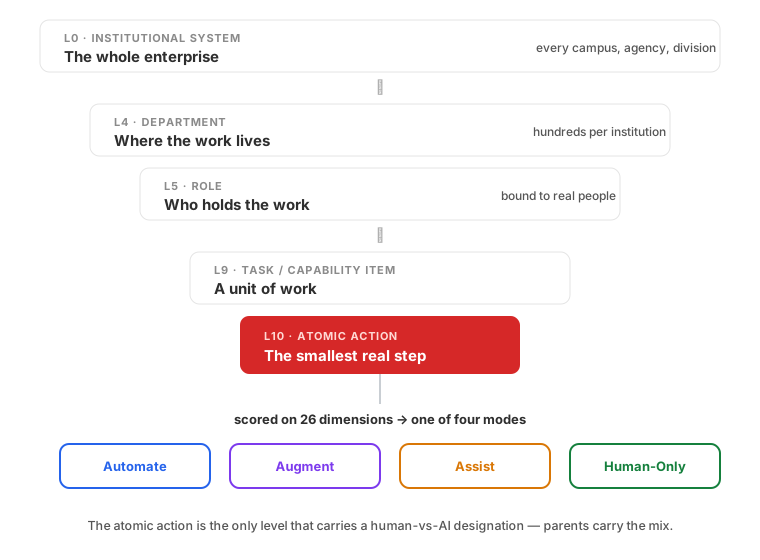
The L0-to-L10 decomposition funnel, ending in the four AAA modes at the atomic action
L0 Institutional System → L1 Institution → L2 Mission Track → L3 Org Unit → L4 Department → L5 Role → L6 Area of Responsibility → L7 Master Task → L8 Sub-Task → L9 Task / Capability Item → L10 Atomic Action

The atomic action is the only level that carries a human-vs-AI designation. The placement is deliberate: a higher-level task is itself a mix of atomic actions, so stamping a single verdict on it would flatten the signal. The parent task carries the mix — so for any task you can see how much is automatable, how much needs a human, and exactly where the boundary falls.

The scoring engine

26 dimensions. Four honest answers.

The Logics Engine scores each atomic action across 26 dimensions in five groups — Task Characteristics, Data & Model Readiness, Risk & Impact, Human Requirements, Operational Maturity — derives an AI-Enablement level and a Trust Tier, and from those places the action in one of four modes.

AutomateAI runs it end-to-end; humans audit out of band.
AugmentAI and human collaborate; humans review or approve at gates.
AssistAI gathers, drafts, and suggests; a human does the actual work.
Human-OnlyA person does it with no AI involved at all.
The engine separates "can it run autonomously?" from "at what consequence?" — so two actions that are equally automatable can land in different modes purely because of stakes.

The platform always explains what each dimension means and why an action landed where it did. The per-dimension weights, the readiness formula, and the policy-floor values are sealed NOW OS intellectual property.

The reasoning layer

A knowledge graph the system reasons over — not a document pile it retrieves from.

All facts live in a connected model of the organization — people, departments, policies, controls, tasks, and the relationships among them. Every answer fuses three layers, and silently invokes the right quantitative technique from a library of 49+ math, statistics, and ML capabilities.

Layer 1

Grounded facts

Retrieved from the organization's knowledge graph — with provenance on every borrowed fact.

Layer 2

Frontier reasoning

A leading AI model reasons natively on top of the graph — synthesis, inference, expert judgment.

Layer 3

Live external currency

Web search when law, regulation, or market facts need to be current — cited, never silently blended.

The agent estate

18 families. ~130 role-specialized agents.

Work is discovered, scored, governed, executed, and audited by named, role-specialized agents — not one copilot doing everything.

Cartographer

Discovers the work model from the organization's real corpus — tasks are found, not hand-authored.

Sentinel

Compliance and security: watches restricted work, flags violations, enforces the floors.

Weightsmith

Runs the 26-dimension scoring that places every action in its mode.

Skillbert

The conversational front end — guided intake that ordinary people can use on day one.

Librarian

Retrieval and citation — every claim traceable to its source.

Ledger

The auditor — a hash-chained record of every decision, re-verified on every read.

…plus analytics (Lens), recommendations (Advisor), workforce strategy (Strategist), and more. "Wired" is enforced, not asserted: every agent identifier must resolve to real executable code, and a build gate fails on any that doesn't.

Trust

An honest data path, end to end.

One governed lane in

Every fact that enters the live graph is validated against schema and contract before it is written, queued for a named reviewer, and re-validated on promotion. One path in, no side door.

Structural governance

The engine recommends; a named human decides; an advisory board governs; every decision is replayable from the ledger. Nothing auto-promotes — by construction, not by policy memo.